
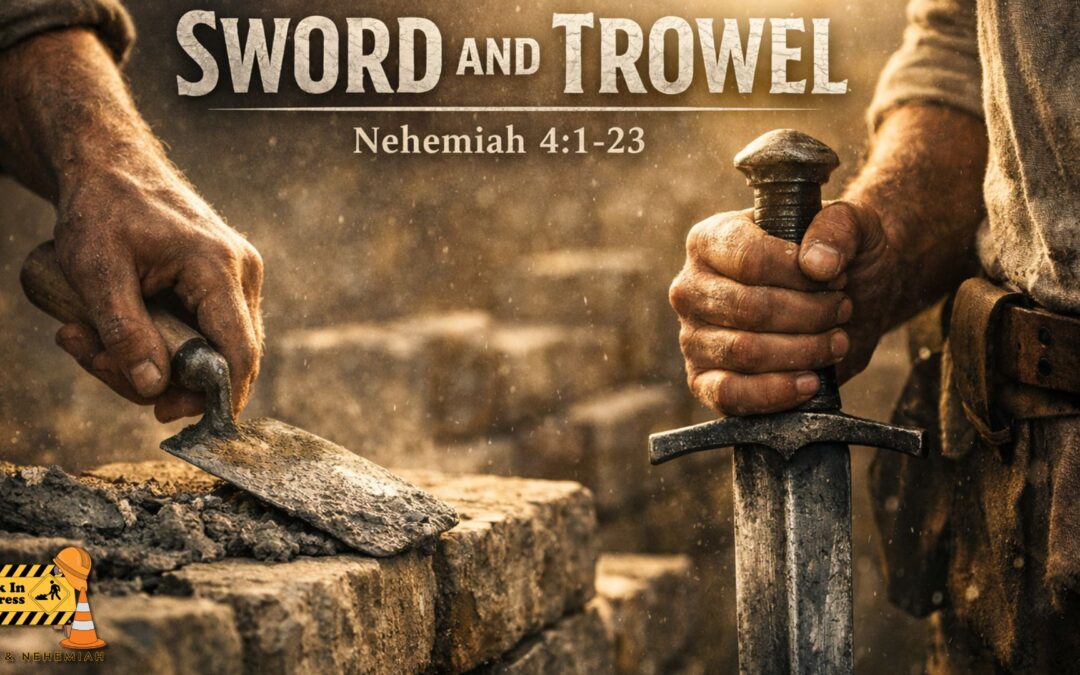
Sword and Trowel
Pastor Brian Carroll
A Work in Progress / Nehemiah 4:1-23
God’s enemies work overtime to stop his Kingdom through ridicule, fear, and threat. Nehemiah’s answer is simple and steady: pray, post a guard, and keep building. In other words, God’s work requires both a trowel and a sword, constructive obedience in one hand and watchful resistance in the other. The danger for us is drifting into one ditch or the other: building without vigilance or fighting without building. Today we’re talking about what it means to remember the Lord, protect what matters, and keep putting stone on stone until the wall goes up.
Introduction - APOLLO 13 VIDEO
• When that oxygen tank exploded aboard Apollo 13, the mission changed in an instant.
• Those brave men had to pivot from explorers to survivors.
• As the situation unfolded, it became clear, If those astronauts were going to make it home alive, they had to do two things at the same time.
• They had to build new solutions that had never existed before, and they had to fiercely guard the fragile systems that were keeping the astronauts alive.
• Inside the spacecraft, Jim Lovell and his fellow astronauts felt the weight of that reality settle over them.
• The explosion damaged their command module and forced them into the lunar module, a small craft that suddenly became their shelter and lifeline - a literal cosmic lifeboat.
• Every breath of air and every unit of power carried new significance.
• Their survival rested on careful attention to the resources in their hands and steady trust in the voices guiding them from Earth.
• Back in Houston, Flight Director Gene Kranz gathered his team and set the tone for the hours ahead.
• One urgent problem quickly came to light as carbon dioxide levels increased inside the cabin.
• The filters on board could not sustain three astronauts for the journey home. They were never designed to be used like that.
• So, a group of engineers spread the available spacecraft parts across a table and began shaping a solution from what the astronauts had available to them.
• Piece by piece, they designed an improvised filter that would keep the air breathable.
• Their work carried the quiet hope of three families and an entire watching world.
• While engineers built, Mission Control had to vigilantly watch resources.
• Power flowed through carefully measured channels.
• Systems cycled down to preserve energy for the final return.
• Each adjustment protected the delicate balance that sustained their lives.
• After four long days, Apollo 13 entered Earth’s atmosphere and splashed down safely in the Pacific Ocean.
• Relief swept through Mission Control and across the world.
• The mission became a testimony to people who held creativity and vigilance in the same hands.
• Their cooperation revealed the strength that grows when wise action and careful vigilance walk side by side.
• Nehemiah 4 places God’s people in a similar moment.
• As they raise Jerusalem’s wall, opposition gathers and pressure increases.
• They learn to carry a trowel in one hand and a sword in the other, building what God has entrusted to them while guarding it with steady vigilance.
• That calling continues to shape the life of God’s people as we pursue faithful work with courage and care.
• We are confronted with plenty of opponents to the Gospel, but we must continue to be about our Father’s business.
• So we have to do our work, but while we do our work, we proceed with an appropriate degree of caution, knowing that there are many who would seek to halt our progress.
• With that, let’s turn our attention to our next stop in the Book of Nehemiah.
• I’ll be taking a look at all of chapter 4 today, however, I will only read a selection of the verses.
Scripture Reading
Nehemiah 4:1–6 ESV
1 Now when Sanballat heard that we were building the wall, he was angry and greatly enraged, and he jeered at the Jews.
2 And he said in the presence of his brothers and of the army of Samaria, “What are these feeble Jews doing? Will they restore it for themselves? Will they sacrifice? Will they finish up in a day? Will they revive the stones out of the heaps of rubbish, and burned ones at that?”
3 Tobiah the Ammonite was beside him, and he said, “Yes, what they are building—if a fox goes up on it he will break down their stone wall!”
4 Hear, O our God, for we are despised. Turn back their taunt on their own heads and give them up to be plundered in a land where they are captives.
5 Do not cover their guilt, and let not their sin be blotted out from your sight, for they have provoked you to anger in the presence of the builders.
6 So we built the wall. And all the wall was joined together to half its height, for the people had a mind to work.
Nehemiah 4:15–20 ESV
15 When our enemies heard that it was known to us and that God had frustrated their plan, we all returned to the wall, each to his work.
16 From that day on, half of my servants worked on construction, and half held the spears, shields, bows, and coats of mail. And the leaders stood behind the whole house of Judah,
17 who were building on the wall. Those who carried burdens were loaded in such a way that each labored on the work with one hand and held his weapon with the other.
18 And each of the builders had his sword strapped at his side while he built. The man who sounded the trumpet was beside me.
19 And I said to the nobles and to the officials and to the rest of the people, “The work is great and widely spread, and we are separated on the wall, far from one another.
20 In the place where you hear the sound of the trumpet, rally to us there. Our God will fight for us.”
• Last week, we took a look at the roll call of chapter 3.
• It was a tour of the walls with the names of everyone involved in the building process.
• What we get when we get to the end of chapter 3 is simply the recognition that the wall is completed.
• However, it is important to note that it wasn’t just smooth sailing.
• It certainly wasn’t like the Temple back in Ezra where you had long pauses in the work, but it is clear in chapter 4 that there were a lot of enemies who were watching as the wall began to take shape…and they didn’t like it.
• That brings us to our first point this morning:
God’s People Must Prayerfully Wage the War of the Words (vv. 1-5)
• Our old buddies, Sanballat and Tobiah, are right where we would expect them to be.
• The bible says that they were angry and enraged.
• Even says that they jeered at the Jews as they worked.
• You can read a selection of the taunts that he offered toward Nehemiah and his fellow builders.
• He calls them feeble. He mocks their pace.
• One of his colleagues even makes an attempt at a bad joke saying that the walls wouldn’t support the weight of a fox.
• When this period of opposition begins, it is all just words.
• We’ve heard the saying, “Sticks and stones may break my bones, but words will never harm me.”
• While words may not be able to inflict physical injury on us, we do know that words aren’t altogether harmless either.
• Words can cut deep - but Nehemiah does give us the solution for hurtful words.
• First, we see what the solution is NOT.
• The solution isn’t to engage in retaliation and argumentation.
• There may be times and places for debates between opponents.
• There have been lots of high-profile debates between Christian apologists and atheists or agnostics over the years.
• You even see the Apostle Paul engaging in what would have been a kind of debate in Acts 17 as he stood in the amphitheater in Athens, engaging with various Greek philosophers.
• However, most of us are unqualified to be in a debate like that and will unlikely ever have the opportunity.
• But that’s simply not the norm for most of us.
• Most of our critics and opponents are not going to be looking for a debate.
• They’re looking for a fight.
• Sanballat and Tobiah weren’t looking for a scholarly debate from Nehemiah…they wanted a fight.
• And if we allow ourselves to get sucked into verbal fights and arguments, it isn’t going to go well - even if we own our critic with our untouchable logic and rock-solid biblical rationale.
• Rare is the moment when engaging in heated arguments with those who hate the things of God will actually prove fruitful.
• In fact, our job isn’t really to win arguments but to be faithful to the Lord’s instructions.
• There are words that are actually beneficial in this battle.
• Nehemiah, being the man he is, reminds us of those words beginning in v. 4.
• He doesn’t engage the enemy - instead he engages the Father.
• We talked about this back in chapter 2 - Nehemiah is an expert at these quick, in-the-moment prayers that help keep him focused on the task at hand.
• Here, we see another example of that.
• His opponents are mocking him, so he prays.
• He doesn’t pray a “peaceful” prayer…he says what is on his heart.
• But that’s the beautiful thing about prayer.
• God is big enough to handle the big emotions we feel when we’re dealing with people like Sanballat.
• You want to call fire down from heaven, you go right ahead.
• But just know that before you ever see the first fireball fill the sky, that the LORD might just work on your heart instead.
• But that’s kind of the point, after all - before we ever consider how we respond to critics and opponents, the first conversation we need to have is with the LORD.
Secondly, we need to make sure that the work we are doing is worth the effort of the critics (v. 6)
• I don’t want to belabor this point, but v. 6 is a good, quick reminder about the significance of the work taking place in Jerusalem.
• They’re rebuilding the wall.
• They’re not building an art museum or a city park.
• Not that there’s anything wrong with art museums or city parks.
• But at this time, God hasn’t commanded the construction of city parks and museums.
• Right now, the expectation is clear - we’re building the wall. The end.
• Honestly, Sanballat and Tobiah probably wouldn’t have cared too much if they were simply adding some green spaces to the city.
• The work that the residents of Jerusalem have united around is very much God’s work.
• Again, it’s just a good reminder for the church to make sure that we’re doing God’s work and not getting distracted by lesser work.
• There are 10,000 different things that the church can do today that has next-to-nothing to do with the Kingdom.
• God has called his church to our primary, non-negotiable mission…
• Make disciples to the ends of the earth.
• That’s our wall…and building it will bring about a TON of opposition.
• And it is work that is worthy of any and all opposition.
• Every day, there are people actively doing that work in dangerous places and they’re facing real, hostile opposition.
• If we’re facing heat because we’ve wandered off mission, that’s not persecution. That’s distraction.
• The church needs to constantly ask the question - Is what we’re doing part of what God has called us to do, or is it some sort of side quest that is really only serving as a distraction?”
• Our spiritual ADHD is real and we need to guard against it.
• This is what we call mission-drift and it is a real and dangerous thing that we must avoid.
• As we continue in this chapter, the progress on the wall is visible.
• Breaches are closing, gates are being put into place.
• And the enemies don’t like any of it.
• So their mocking and scorn takes on a new dimension.
• It says in v. 8 that these opponents begin to get organized to take action. Their mocking turns into threats.
• However as we keep reading, we actually find that some of the greatest hindrance to the work isn’t the pagans on the outside.
Sometimes, the greatest hindrance to the work of God comes from those who are on the inside (vv. 10-15)
• When we get to v. 10, it looks like the workers get overwhelmed with both the scope of the job and the heat of the critics.
• It specifically says, “The strength of those who bear the burdens is failing…”
• Undoubtedly, this had to be a discouraging work.
• Apparently, there were some Jews who were not part of the rebuild, but who lived around Jerusalem.
• As they got wind of the discouragement of the laborers and the threats of violence from the Gentiles, they came to Jerusalem and basically demanded that the workers return home.
• They didn’t want their loved ones caught up in any kind of violence against the city.
• These folks aren’t necessarily malicious, but they do seem to be a people who are afraid.
• That’s not an invalid concern, but it does ignore one of the main ideas that Nehemiah is built on.
• Nehemiah expresses it in Nehemiah 4:14 “Do not be afraid of them. Remember the Lord, who is great and awesome, and fight for your brothers, your sons, your daughters, your wives, and your homes.”
• This concern is enough to disrupt the work for a moment.
• This disruption wasn’t directly caused by Nehemiah’s enemies, but by the friends and families of the workers.
• Sadly, Christians can quickly lose our focus on Kingdom work.
• That reminds me of the story of Adoniram Judson - a missionary from the early 1800s.
• He was brilliant, well-educated, and positioned for a comfortable life in ministry in New England.
• His father was a faithful Congregational pastor. A godly man. A man who had prayed for his son to serve the Lord.
• And Judson did want to serve the Lord.
• But during his time at seminary, he became convinced that God was calling him to take the gospel to people who had never heard it — overseas.
• Not for a short trip. Not for a season. But for life.
• When he told his father of his plans, the response was not applause - It was heartbreak.
• This wasn’t opposition from pagans or critics of Christianity.
• This was a father who loved his son deeply.
• He saw the dangers clearly — disease, shipwreck, imprisonment, early death.
• At that time, missionaries rarely came home.
• To leave for Burma was to leave almost everything familiar behind, possibly forever.
• His father urged caution. He hoped his son would reconsider. He feared that this calling was reckless.
• Imagine the tension in that room.
• A son convinced that obedience required departure.
• A father convinced that departure might cost him his son.
• Judson ultimately went.
• He wasn’t angry or rebellious. He wasn’t slamming the door on his family.
• But he was leaving in quiet, costly obedience.
• And his father’s fears were not exaggerated.
• Judson endured imprisonment.
• He buried his wife. He suffered immensely.
• Yet through decades of labor, a church was planted in Burma that would endure long after he was gone.
• Here’s the point: Judson’s greatest resistance did not come first from enemies overseas.
• It came from someone inside his own community. Someone who loved him.
• Someone who wanted what was best for him.
• And that’s often how opposition works.
• Sometimes the hardest pushback you will face when you step into God’s work does not come from the outside world.
• It comes from people close to you. People who are sincere. People who are cautious. People who are afraid.
• Nehemiah doesn’t dismiss the feelings of these folks as being irrational or unimportant.
• Instead, he figures out how to both accomplish the work God had called them to WHILE taking steps to protect the work and the workers from harm.
• In the parts of the wall where they were the most vulnerable, Nehemiah positioned well-prepared troops.
• He also did it by family - another stroke of spirit-empowered genius.
• He knew that those families fighting in the same space would have increased the morale and the commitment of those standing in the gaps.
• With that, the work continues.
• The pagans saw troops where they once saw vulnerabilities.
• The builders became aware of the danger and took steps to mitigate the danger.
• They were armed with the tools of protection in one hand and the tools of rebuilding in the other hand.
• With sword and trowel, the work continued and in that way the work was completed.
• And that brings about the last point.
Vigilance and faithfulness must go hand in hand (vv. 15-23)
• I think we would all agree that it is foolish if we know there is risk and we don’t take responsible steps to mitigate that risk.
• This is part of our life today.
• If you’re working in the sun, you put on a hat and wear sunscreen.
• If you’re working around heavy equipment, you probably don’t show up at work in flip flops and likely will opt for a sturdier shoe.
• You put your baby in the car and you strap them in like they’re about to board Apollo 13.
• We see that in God’s kingdom too…
• We send missionaries to hard places and we provide training for all of the potential challenges they might encounter.
• I remember being on a mission trip once in Jamaica.
• We had partnered with a small church and were doing some work on the church.
• There was a group of guys that showed up one day and it was pretty clear that they were there to “observe” the young ladies who were on the trip with us.
• So we made it a point that there was always a grown man on our team watching those guys, keeping a tab on their whereabouts and even talking with them when given the opportunity.
• The wise church today has a plan in place for some of the nonsense that is going on.
• Our church is no different with locked and monitored doors and parking lot attendants.
• That’s not a lack of trust - that’s the same kind of wisdom we see demonstrated in Nehemiah.
• But I do want to make sure to acknowledge something important.
• If we are only vigilant to physical threats, then we’re missing where our greatest threats may actually come from.
• Remember, Paul warned in Ephesians 6:12 that our battle is not against flesh and blood, but against spiritual forces.
• The media makes a big deal about church protesters and violent acts against churches (and they should).
• Those are atrocities that have no place in modern societies.
• But if I’m being honest, and ya’ll know I am going to be honest.
• We rightfully spend a ton of man-hours, mental capital, and physical capital to keep us safe from those opponents.
• How much are we spending in our vigilance against those far more common spiritual opponents.
• The odds are that you could attend church every time the doors are open for the rest of your life and never be a victim of violence or the target of a protest.
• That’s just statistics…I’m not saying it can’t happen, I’m just saying the odds against it happening are high.
• However, there is a greater enemy that is waging war against your faithfulness every day of your life.
• What do this enemy’s attacks look like?
• Apathy - When you find yourself not caring or caring less, that’s not a work of the Spirit.
• Misplaced priorities - When you find other things taking on greater significance than they ought.
• Besetting sin - When you find old sinful patterns taking hold again (or when new patterns are developing).
• Paul gives a great list in Col. 3:5-9
Colossians 3:5–9 ESV
5 Put to death therefore what is earthly in you: sexual immorality, impurity, passion, evil desire, and covetousness, which is idolatry.
6 On account of these the wrath of God is coming.
7 In these you too once walked, when you were living in them.
8 But now you must put them all away: anger, wrath, malice, slander, and obscene talk from your mouth.
9 Do not lie to one another, seeing that you have put off the old self with its practices
• Those are the things we have to worry about and remain vigilant about.
• Those are the opponents that want to render you ineffective and take you out of the work.
• And they’re very good at it.
• How do we stay vigilant?
• Well, we need to do it in community.
• Nehemiah had entire families in the fight together.
• As much as we serve through the church, we need the community of the church.
• And we need to make sure we’re practicing that which Nehemiah was so good at - prayer.
• You’re not going to manage these opponents away.
• You’re not going to self-discipline these opponents away.
• You’re going to need help - and that comes through God’s help.
• And just like Nehemiah armed his workers with a sword, you’re going to need a really reliable sword in your battle as well.
• Ephesians 6:16–17 “16 In all circumstances take up the shield of faith, with which you can extinguish all the flaming darts of the evil one; 17 and take the helmet of salvation, and the sword of the Spirit, which is the word of God,”
• God has provided you with everything you need to stand firm against your greatest opponents…you just have to be willing to arm yourself for the fight.
Invitation
• The wall did not rise because the threats disappeared.
• It rose because the people kept building.
• They prayed when they were mocked.
• They remembered the Lord when they were afraid.
• They worked with one hand and stayed watchful with the other.
• And that’s the invitation for us.
• Not to chase conflict.
• Not to measure success by applause or opposition.
• But to make sure we are building what God has actually called us to build.
• If you’re weary, strengthen your hands.
• If you’ve drifted, return to the work.
• If you’re discouraged, remember the Lord who fights for His people.
• Let’s be a church that builds faithfully and stays vigilant until the work is done.
Exported from Logos Bible Study, 9:14 AM February 15, 2026.