
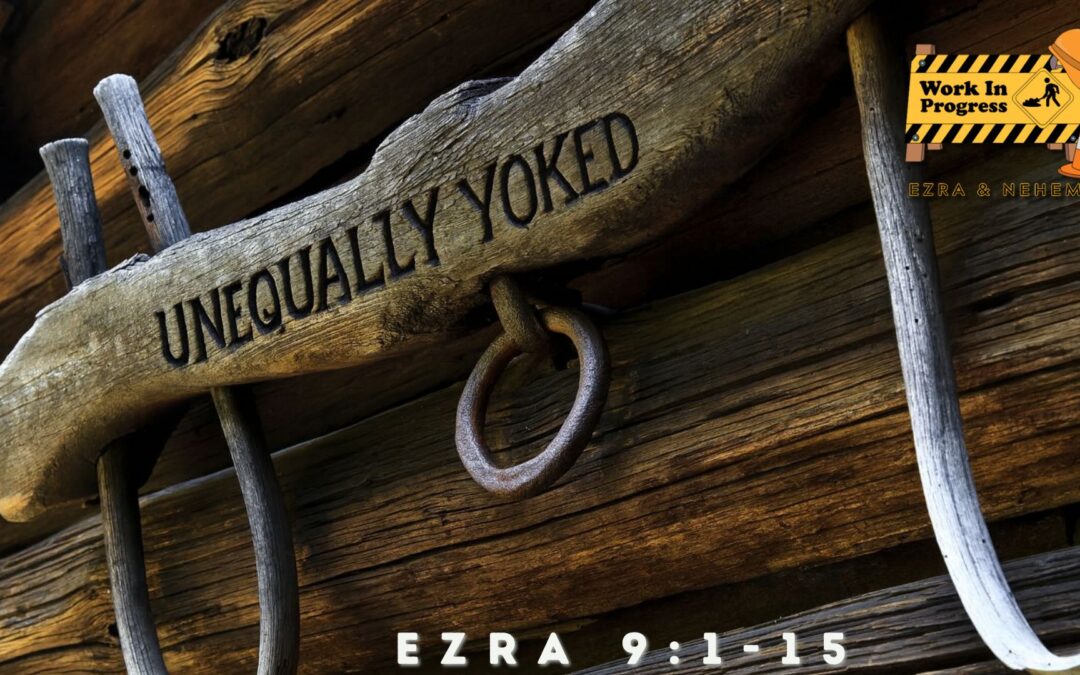
Ezra 9:1–15
1 After these things had been done, the officials approached me and said, “The people of Israel and the priests and the Levites have not separated themselves from the peoples of the lands with their abominations, from the Canaanites, the Hittites, the Perizzites, the Jebusites, the Ammonites, the Moabites, the Egyptians, and the Amorites.
2 For they have taken some of their daughters to be wives for themselves and for their sons, so that the holy race has mixed itself with the peoples of the lands. And in this faithlessness the hand of the officials and chief men has been foremost.”
3 As soon as I heard this, I tore my garment and my cloak and pulled hair from my head and beard and sat appalled.
4 Then all who trembled at the words of the God of Israel, because of the faithlessness of the returned exiles, gathered around me while I sat appalled until the evening sacrifice.
5 And at the evening sacrifice I rose from my fasting, with my garment and my cloak torn, and fell upon my knees and spread out my hands to the Lord my God,
6 saying: “O my God, I am ashamed and blush to lift my face to you, my God, for our iniquities have risen higher than our heads, and our guilt has mounted up to the heavens.
7 From the days of our fathers to this day we have been in great guilt. And for our iniquities we, our kings, and our priests have been given into the hand of the kings of the lands, to the sword, to captivity, to plundering, and to utter shame, as it is today.
8 But now for a brief moment favor has been shown by the Lord our God, to leave us a remnant and to give us a secure hold within his holy place, that our God may brighten our eyes and grant us a little reviving in our slavery.
9 For we are slaves. Yet our God has not forsaken us in our slavery, but has extended to us his steadfast love before the kings of Persia, to grant us some reviving to set up the house of our God, to repair its ruins, and to give us protection in Judea and Jerusalem.
10 “And now, O our God, what shall we say after this? For we have forsaken your commandments,
11 which you commanded by your servants the prophets, saying, ‘The land that you are entering, to take possession of it, is a land impure with the impurity of the peoples of the lands, with their abominations that have filled it from end to end with their uncleanness.
12 Therefore do not give your daughters to their sons, neither take their daughters for your sons, and never seek their peace or prosperity, that you may be strong and eat the good of the land and leave it for an inheritance to your children forever.’
13 And after all that has come upon us for our evil deeds and for our great guilt, seeing that you, our God, have punished us less than our iniquities deserved and have given us such a remnant as this,
14 shall we break your commandments again and intermarry with the peoples who practice these abominations? Would you not be angry with us until you consumed us, so that there should be no remnant, nor any to escape?
15 O Lord, the God of Israel, you are just, for we are left a remnant that has escaped, as it is today. Behold, we are before you in our guilt, for none can stand before you because of this.”
Unequally Yoked
Brian Carroll / General Adult
Work in Progress / Ezra 9:1-15
Ezra 9 opens with devastating news: after all God had done to restore His people, many of them — including leaders — had fallen back into the same sins that led their ancestors into exile. The very people God had rescued were already compromising their holiness. And when Ezra hears it, he doesn’t shrug, blame, or distance himself. He breaks.
His response is one of holy grief. He tears his garments, falls to his knees, and lifts a prayer that is as honest as it is humble. Ezra doesn’t defend the people or minimize their sin; he lays it bare before God, confessing not just their guilt, but our guilt. Ezra models the kind of heart God honors — a heart that feels the weight of sin because it treasures the holiness and mercy of God.
Introduction - Challenged Leadership
• You may remember the Challenger disaster back in 1986.
• I was listening recently to a podcast series about it, and one thing really struck me: the disaster didn’t come out of nowhere.
• It wasn’t sudden. It wasn’t unpredictable.
• In fact… the truth is almost harder to hear.
• The night before the launch, the engineers were pleading — literally pleading — for someone to listen.
• The forecast was calling for freezing temperatures. They said the launch tower was even covered with ice.
• And here’s the problem: the solid rocket boosters (that’s those two white rockets on the side of the orange thing) had these giant rubber O-rings (they were like 20’ across) that were designed to keep hot gasses away from combustible fuel.
• And guess what, rubber doesn’t like cold.
• In warm weather, those O-rings flex and seal instantly.
• But in cold weather? They get stiff. They get brittle.
• They don’t respond the way they’re supposed to.
• And the engineers said, “If we launch in this cold, the O-rings won’t seal. When those boosters ignite, the joints are going to flex — they always flex — and if the O-rings can’t move with them, a flame is going to slip through the gap. And if that happens… we’re going to lose the vehicle and the crew.”
• They knew exactly what would happen.
• They had the data.
• They raised the warning.
• They were unanimous: Do not launch.
• But leadership didn’t want a delay. They didn’t want headlines.
• They didn’t want to explain why the schedule slipped again.
• So instead of humility, they applied pressure.
• Instead of caution, they used sarcasm.
• Instead of responsibility… they spun a story.
• And the next morning, in full view of the world, their refusal to face the truth ended in tragedy.
• That’s what bad leadership does:
• It hides the cracks.
• It buries the warnings.
• It shifts the blame.
• It protects the image instead of the people.
• Now… hold that picture in your mind, because in Ezra 9 we meet a leader who does the exact opposite.
• When Ezra hears the bad news, he doesn’t downplay it.
• He doesn’t deflect it. He doesn’t look for someone else to pin it on.
• He doesn’t say, “Well, that happened before my time.”
• Ezra tears his garments.
• He falls on his knees.
• He confesses sin he didn’t personally commit.
• He brings the whole broken mess before God as if it were his very own.
• Where those Challenger managers hid the truth, Ezra drags it into the light.
• Where they protected their image, Ezra lowers himself in humility.
• Where they denied responsibility, Ezra embraces it — fully.
• And church, that’s the kind of leadership God honors.
• Not leadership that pretends everything is fine…
• But leadership that trembles at His Word, faces the truth head-on, and leads God’s people back toward faithfulness.
• We’ve seen Ezra the leader preparing his people for the journey.
• But now he’s the guy in charge and we get to see him respond to sin.
• Let’s go ahead and jump into Ezra 9 - I’ll be covering the whole chapter, but will only read the first 12 verses.
Scripture Reading
Ezra 9:1–12 ESV
1 After these things had been done, the officials approached me and said, “The people of Israel and the priests and the Levites have not separated themselves from the peoples of the lands with their abominations, from the Canaanites, the Hittites, the Perizzites, the Jebusites, the Ammonites, the Moabites, the Egyptians, and the Amorites.
2 For they have taken some of their daughters to be wives for themselves and for their sons, so that the holy race has mixed itself with the peoples of the lands. And in this faithlessness the hand of the officials and chief men has been foremost.”
3 As soon as I heard this, I tore my garment and my cloak and pulled hair from my head and beard and sat appalled.
4 Then all who trembled at the words of the God of Israel, because of the faithlessness of the returned exiles, gathered around me while I sat appalled until the evening sacrifice.
5 And at the evening sacrifice I rose from my fasting, with my garment and my cloak torn, and fell upon my knees and spread out my hands to the Lord my God,
6 saying: “O my God, I am ashamed and blush to lift my face to you, my God, for our iniquities have risen higher than our heads, and our guilt has mounted up to the heavens.
7 From the days of our fathers to this day we have been in great guilt. And for our iniquities we, our kings, and our priests have been given into the hand of the kings of the lands, to the sword, to captivity, to plundering, and to utter shame, as it is today.
8 But now for a brief moment favor has been shown by the Lord our God, to leave us a remnant and to give us a secure hold within his holy place, that our God may brighten our eyes and grant us a little reviving in our slavery.
9 For we are slaves. Yet our God has not forsaken us in our slavery, but has extended to us his steadfast love before the kings of Persia, to grant us some reviving to set up the house of our God, to repair its ruins, and to give us protection in Judea and Jerusalem.
10 “And now, O our God, what shall we say after this? For we have forsaken your commandments,
11 which you commanded by your servants the prophets, saying, ‘The land that you are entering, to take possession of it, is a land impure with the impurity of the peoples of the lands, with their abominations that have filled it from end to end with their uncleanness.
12 Therefore do not give your daughters to their sons, neither take their daughters for your sons, and never seek their peace or prosperity, that you may be strong and eat the good of the land and leave it for an inheritance to your children forever.’
• So Ezra has been in Jerusalem for about 4 months.
• He’s grown up in Babylon, but he’s an expert in the Law.
• He knows it , he lives it, he teaches it.
• The king of the empire, Artaxerxes at the time, has favor on Ezra and sends him back to Jerusalem to make sure that everyone there knows how to behave to make sure the God of Israel doesn’t get too angry and take his frustrations out on the Persians.
• So Ezra gathers a substantial group of Jews to make the return trip with him and they head back to Jerusalem.
• Ezra no more than gets his U-Haul unloaded and he is immediately confronted with his first significant leadership challenge.
• What’s the problem?
• A generation has passed from the time the book of Ezra first started until now.
• And all of those children born in Jerusalem have grown up and started taking leadership positions.
• But that’s not the only thing they’re taking.
• They started looking around the neighborhood and found that they really preferred the girls from, shall we say, “the other side of the tracks.”
• Instead of marrying within the Jewish faith, they’re marrying women from all kinds of other religious influences.
• Please keep in mind that this is not some obscure, Old Testament regulation.
• The New Testament expresses this issue in the phrase “unequally yoked” from 2 Corinthians 6
• The big idea is that believers and nonbelievers shouldn’t enter into a marriage relationship.
• Students, we used to call it “missionary dating.” You would go out with a nonbeliever in the hopes that your positive Christian witness would win your boyfriend or girlfriend to Christ.
• I’m not saying that never happens, but most of the time it is going to drag you down rather than you winning your non-Christian ladyfriend or boyfriend to Christ.
• The exception to this would be when both spouses get married as nonbelievers.
• However, if one of the spouses comes to faith in Christ, they are to stay married (1 Cor. 7:13)
• Just for the record, I will not officiate a wedding for a believer and a nonbeliever on this basis.
• For Ezra’s generation, let’s just say this: You don’t have to be a history scholar to know that this is a bad idea - King Solomon should come to mind.
• Exodus 34 warns about making covenants with the groups like the Amorites and Canaanites. Marriage would certainly qualify as a covenant.
• Deuteronomy 7:3 says explicitly - “3 You shall not intermarry with them, giving your daughters to their sons or taking their daughters for your sons,”
• So, in the list of things NOT to do in Israel, this is pretty high up there.
• This isn’t about race or culture, this is really about fidelity to God.
• Some Christians have wrongly used these texts to justify racist attitudes…that’s not what we’re saying here.
• These outside groups have proven themselves that they don’t care anything about fidelity to God.
• They’ve consistently been a source of idolatry for the people of Israel.
• To understand more specifically why this intermarrying thing is an issue, just consider how the psalmist described the influence the people of these other nations had on Israel:
Psalm 106:34–39 ESV
34 They did not destroy the peoples, as the Lord commanded them,
35 but they mixed with the nations and learned to do as they did.
36 They served their idols, which became a snare to them.
37 They sacrificed their sons and their daughters to the demons;
38 they poured out innocent blood, the blood of their sons and daughters, whom they sacrificed to the idols of Canaan, and the land was polluted with blood.
39 Thus they became unclean by their acts, and played the whore in their deeds.
• But it isn’t just that you’ve got a few random Jewish guys that have settled down with a few random Canaanite gals.
• When Ezra learns about the problem, he learns that this is an issues with the priests and the Levites.
• The end of v. 2 is a stunning indictment, “And in this faithlessness the hand of the officials and chief men has been foremost.”
• The chief offenders are the very ones who should be speaking out against it, not embracing it themselves.
• Beyond that, they seem to be the chief offenders.
• This points to an important question that God’s people of every generation must answer:
How do you find the balance between separation and cultural engagement?
• On one hand, we would quickly recognize the principle of being unequally yoked.
• There really aren’t any questions there.
• Those who are Christians should not seek marriage with those who are not.
• In the intimacy of that relationship, there really is no business for the co-mingling of Christian convictions and, I’ll just go with “less-than-Christian convictions.”
• When I say cultural engagement, I’m not talking about engagement in marriage terms.
• I’m talking about our evangelistic responsibilities to our neighbor.
• Jesus was often described as a “friend of sinners.”
• He spent time with people who did not share his convictions.
• He had dinner with them, had meaningful conversations with them.
• He engaged with their arguments, answered their questions, loved them in spite of their flaws.
• For the record, you should be very thankful that Jesus was a friend of sinners.
• That means he engaged YOU before you were part of his family.
• All that to say that there are certain relationships where separation from non-Christians is appropriate.
• At the same time, we have to maintain healthy relationships with non-Christians because that is the model that Jesus gave us.
• If you aren’t yet married, and you’re old enough to know that koodies aren’t real, you had better make sure that the #1 thing you’re looking for in a partner is shared Christian convictions.
• And it better be more than lip service…they’d better have some fruit that aligns with their stated convictions.
• Whether you are married or not, it is wise to pay attention to who you share your heart with.
• The reason is very simple…
• You want to be the influencer, not be the influenced.
• You want to engage the culture, be a friend of sinners like Jesus.
• But you don’t want the sinners you engage cause you to stumble.
• This is very much where Israel failed,
Ezra knows that intermarriage has had catastrophic consequences in the past.
• We’re told in v. 3 that Ezra is overwhelmed by a very physical manifestation of grief and conviction.
• He tears his clothes and pulls his hair.
• Remember, he’s an expert in the law…he trembles at the word of God because he knows.
• And he kind of sits there stunned for a while.
• When he finally gathers his composure enough, he sets the example for us - he prays.
• But he doesn’t just pray “shame on all you sinners.”
• Instead he prays as a member of his community, not as one sitting in judgment of his community.
• His prayer has three different emphases.
• First, he recalling of Israel’s history and the guilt that had accrued to them over the years due to their disobedience of God and his Word (vv. 6–7).
• Second, he considers the steadfast love of God that had not given up on them. (vv. 8-9)
• Rather, in his mercy and grace, he had brought them into this situation of revival and restoration by bringing them home to build the temple.
• Finally, And then he cries out in astonishment that despite the lessons of the past they were repeating their failures all over again, having “forsaken your commandments” (9:10).”
• He calls upon God’s mercy, noting that their God hasn’t punished them in the fullness of what they deserved.
• But he rightly notes that God has the prerogative to “consume them” so that their remnant would be no more.
• He acknowledges that they are a remnant, and they do deserve punishment, and he ends the chapter by humbly throwing himself and the nation before the justice and mercy of God.
Ezra 9:15 ESV
15 O Lord, the God of Israel, you are just, for we are left a remnant that has escaped, as it is today. Behold, we are before you in our guilt, for none can stand before you because of this.”
• When we consider Ezra’s response to this situation, there are a couple of things that we need to note.
First of all, we need to beware of how we build up our own “sin tolerance.”
• This intermarriage problem wasn’t something that just happened overnight.
• Somebody crossed the line and when that person crossed the line, another person thought they could cross the line.
• Lather, rinse, repeat.
• Before too long, you’ve got an entire culture that has gone down a road that God is very much in opposition to.
• Ezra’s prayer very much puts all of this into perspective.
• This is not a laughing matter, it is a serious situation.
• They’re going to come up with a radical, and very controversial solution in the next chapter.
• They’re following in the footsteps of generational sin.
• They’re disregarding the clearest of God’s commandments.
• All of this is expressed in Ezra’s prayer.
• I think we have to be very mindful of how we build up a tolerance for sin as we are exposed to it over and over again.
Senator Daniel Patrick Moynihan, published his classic essay “Defining Deviancy Down” in 1993. In that essay, he concluded that the amount of deviant behavior in American society has increased beyond the levels the community can “afford to recognize” and that, accordingly, we have been redefining deviancy so as to exempt much conduct previously stigmatized and also quietly raising the “normal” level in categories where behavior is now abnormal by any earlier standard. The reasons, he said, were altruistic, opportunistic, and denial, but the result was the same: an acceptance of mental pathology, broken families, and crime as a fact of life.
• Defining Deviancy Down in brief - we call that which is unacceptable acceptable so that it becomes a normal part of our existence.
• How often do you smell marijuana today compared to a decade ago?
• What happened?
• People started saying, “You know what, that stuff isn’t all bad.”
• “We should ‘decriminalize’ this substance.”
• And suddenly, you’ve got more weed shops than Dollar Generals and kids are getting out of their parents cars at school smelling like they stepped out of a Cheech and Chong movie.
• I would imagine that’s exactly how a generation of Israelites got to this place that comes to a head in Ezra 9.
• Enough people said “this is okay” so that it became “okay.”
• But God never said it was okay.
• In fact, God’s standard has been all along, Isaiah 5:20 “20 Woe to those who call evil good and good evil, who put darkness for light and light for darkness, who put bitter for sweet and sweet for bitter!”
• Let’s not pretend we don’t see this in the church today (even if we’re afraid to talk about it).
• Christian couples living together outside of marriage because that’s what everyone does.
• Sex has become a regular, almost expected part of the dating and courtship scene even though God’s standards haven’t changed any.
• You might just be astonished if you went up to UTC and asked students what they thought about these issues.
• You’d likely find a wide embrace
• And as our culture changes the definition of deviancy, we find many in the church embrace society’s definition rather than God’s.
• This moment in Ezra’s story is a very important reminder that it must be different among the people of God.
• Our standards of right and wrong are must be informed by God’s Word, not by the whims of our society that no longer has any kind of moral foundation.
• God has drawn the line for us, we just have to answer whether or not we’re willing to hold that line in the face of cultural opposition.
• Romans 8:29 says that we are to be conformed to the image of Jesus.
• That’s the only standard that matters.
Secondly, Ezra’s leadership points to a Greater Leader
• Ezra doesn’t cast judgment and call for God’s wrath, instead he takes his place among the rebels.
• Ezra intercedes for the community and numbers himself with the transgressors using words such as “our,” “we,” or “us” throughout his confession.
• He uses a couple of important verbs there in v. 6, I am ashamed and blush.
• The word for blush frequently found together.
• The Hebrew verb translated here as “blush,” is elsewhere rendered:
• “put to . . . dishonor” (Ps. 35:4),
• “confounded” (Isa. 45:16, 17;
• “disgraced” (Isa. 50:7).”
• All of these words express the reality of Ezra’s first-person emotional pain at this corporate failure.”
• Even though Ezra wasn’t guilty of this sin, he comes before the LORD in the humble recognition that the iniquity and guilt of the nation are his, and he longs for their holiness.
• Ezra steps in as the mediator for his people, but we live under the new covenant and we have no need for a human mediator, such as a priest.
• Instead, the bible teaches us that we a have a greater mediator.
• The Prophet Isaiah saw this great mediator in the person of Jesus.
Isaiah 53:12 ESV
12 Therefore I will divide him a portion with the many, and he shall divide the spoil with the strong, because he poured out his soul to death and was numbered with the transgressors; yet he bore the sin of many, and makes intercession for the transgressors.
• The Apostle Paul said:
1 Timothy 2:5–6 ESV
5 For there is one God, and there is one mediator between God and men, the man Christ Jesus,
6 who gave himself as a ransom for all, which is the testimony given at the proper time.
• Jesus did what no priest could ever do.
• Ezra could never do this.
• He became the mediator by offering himself as the sacrifice for sin.
• Ezra could pray for the sins of his nation, but he couldn’t atone for the sins of his people.
• Jesus became our great mediator because he literally took our sin upon himself…”He bore the sin of many.”
• In that way Ezra points us to Jesus, the greater priest and mediator.
Invitation
• Ezra doesn’t let us walk away lightly.
• Ezra refuses to pretend.
• He refuses to make excuses.
• He refuses to treat sin like a scheduling conflict — inconvenient, but manageable.
• When he sees the sin of his community, he falls on his face.
• And that response isn’t dramatic… it’s appropriate.
• The now deceased, and disgraced evangelist once said, “Sin always takes us further than we planned to go, keeps us longer than we intended to stay, and costs us more than we ever imagined paying.”
• Unfortunately, his life was very unfortunate example of this.
• But here’s the good news — and don’t miss this —
• Ezra falls on his face not because God is absent, but because God is present.
• Only people who believe God is merciful bother confessing honestly.
• Only people who believe God restores dare to repent deeply.
• Only people who know God is faithful fall before Him instead of running from Him.
• Church, if we’re honest, some of us have gotten good at managing sin instead of killing it.
• We redefine it.
• We downplay it.
• We excuse it because “everybody else is doing it.”
• We compare ourselves to people who we dee to be worse than us instead of a God who is holy.
• But Ezra shows us the way back — not through spin, not through excuses, not through pretending — but through humble, honest confession before a God whose mercy is deeper than our rebellion.
• And here’s the really good news:
• Ezra could fall on his face because he hoped God would forgive.
• We can fall on our face because we know God has forgiven — through Jesus, our greater Mediator.
• Ezra stood with the guilty.
Jesus stood in the place of the guilty.
• Ezra tore his garments.
Jesus tore the veil.
• Ezra confessed sin.
Jesus became sin for us.
• Ezra cried out for mercy.
Jesus purchased mercy with His own blood.
• So here’s the invitation today — not to shame, not to self-loathing, not to spiritual theatrics…but to honesty.
Real honesty.
• Honesty that says, Lord, here it is. All of it.
• The places I’ve compromised.
• The sins I’ve tolerated.
• The patterns I’ve ignored.
• The attitudes I’ve excused. I’m done hiding.
• I’m done pretending. I’m done redefining what You’ve already defined.
• Church, what God reveals, He intends to heal.
What God uncovers, He intends to cleanse.
What God convicts, He intends to restore.
• So today would you be willing to bring that place of compromise, that habit you’ve let slide, that attitude you’ve baptized as “not that bad”… and lay it before the Lord?
• Not to earn His mercy… but because His mercy is already yours in Christ.
Exported from Logos Bible Study, 9:49 AM November 23, 2025.